Summer Reading Challenge Libraries Rock T Shirt
Team-edifice games and activities are a fun manner to help students larn to piece of work together, mind carefully, communicate conspicuously, and think creatively. They also give your students the take chances to get to know each other, build trust every bit a community and, best of all, have fun! Below nosotros've gathered team-building games and activities for the classroom. If you're looking for online team-edifice activities, we have those too!
Watch the video below to meet three of our favorite in-person team-building games in activeness, then read on for more ideas.
i. Seeing spots
For this action, you'll place a colored sticker dot (blue, red, light-green, or yellow) on each student's forehead, without them knowing what color information technology is. When the game begins, each "team" of students (with the aforementioned colour) must observe each other—without speaking. This is a wonderful team-building activeness because it encourages non-verbal communication and cooperation.
2. Mutual thread
Dissever students into groups of 4 and have them sit together as a small group. Give each group v minutes to conversation among themselves and observe something they all have in common. Information technology could exist that they all play soccer, or pizza is their favorite dinner, or they each take a kitten. Whatever the common thread, the conversation will aid them get to know one some other better. Check in with the groups later on five minutes to run across if they need more time. Subsequently each group has come upwardly with their mutual element, have them work together to create a flag that represents it.
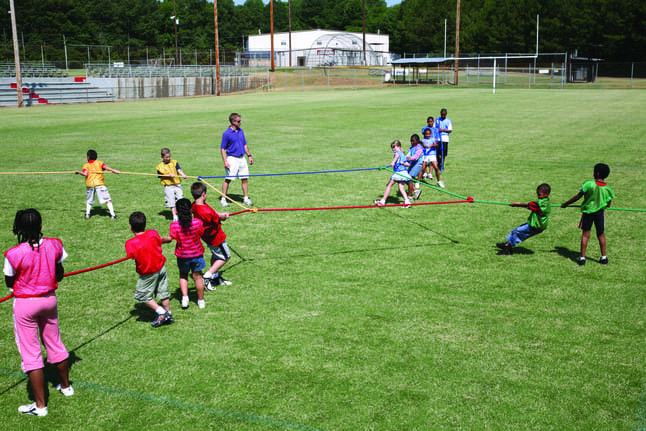
3. Four-way tug of state of war
Source: School Specialty
This fun outdoor activity is double the fun of the traditional tug of war. Tie two long spring ropes together at their centre points, creating an X shape. Tie a bandana around the center signal. Adjacent, utilize cones to course a circle that fits around the X. Form iv equal teams, and have each squad stand at ane of the iv ends of the ropes. At your signal, each squad begins pulling. The objective is to be the first team to pull the others in their management far enough for the bandana to cross to the outside of the circle of cones. Students who feel nervous nigh participating can serve every bit referees, making certain everyone is safe.
four. Classification
For this activity, prepare a tray with 20 unrelated items, for case, a spool of thread, an eraser, a juice box, etc. Alternatively, create a document with twenty images of items to put upwardly on the screen. Separate your class into even groups. Set a timer and have each grouping divide the 20 items into iv categories that make sense to them. For instance, they may put an earring, a glove, a headset, a sock, and a grinning into the category "things you lot article of clothing." Have groups work quietly so that their ideas are kept secret. When each group is finished, give each 1 time to present their categories and their rationale backside each category.
5. Railroad tracks
Lay out two long ropes parallel to i another and have students line up in the center. Phone call out a set of opposites similar sweet or sour, day or night, cat or dog. Students will jump over the left rope if they adopt the first one or over the right rope if they prefer the second ane. Give them a infinitesimal to look around, and so have everyone return to the middle. This activity is a proficient style to go to know classmates meliorate and to run into who they have preferences in common with.
6. Go no-contact
At this bespeak in time, school districts are uncertain whether there will exist COVID restrictions in the classroom this autumn or not. Hither is a collection of over 40 games and activities for students to get to know 1 another and work together while maintaining a safe social distance.
seven. Hot seat
This fun game is a lot like the game bear witness Password. Split your class into two teams and have them sit together in teams facing the whiteboard or chalkboard. Then accept an empty chair—one for each team—and put it at the forepart of the course, facing the squad members. These chairs are the "hot seats." Choose one volunteer from each squad to come and sit in the "hot seat," facing their teammates with their back to the board.
Prepare a list of vocabulary words to use for the game. Choose one and write it clearly on the board. Each squad will accept turns trying to get their teammate in the hot seat to estimate the word, using synonyms, antonyms, definitions, etc. Make sure squad members work together so that each member has a risk to provide clues.
The student in the hot seat listens to their teammates and tries to guess the give-and-take. The first hot seat student to say the word wins a point for their team. Once the discussion is successfully guessed, a new student from each squad sits in the hot seat, and a new round begins with a unlike word.
8. Altogether line upward

Source: Uber-Dork
This is a fun action to get kids lined up. It may accept 5–10 minutes, depending on the historic period of your students, so plan accordingly. The objective is to have students line up in society of their birthdays—Jan 1st through December 31st. To do this, they volition need to know the guild in which the months fall as well as their own altogether. They will as well demand to talk with one some other in guild to figure out who goes in front of whom. To make it super challenging, tell them they must do it without speaking at all, only using hand signals.
9. The perfect square
This activity requires strong verbal advice and cooperation. All y'all need is a long rope with the ends tied together and something to serve as blindfolds for students, such equally bandanas or material strips. Have students stand up in a circle holding the rope in front of them. Signal them to put their blindfolds on and set up the rope on the ground in front end of them. Ask students to turn and walk a brusk altitude away from the circle. Assign a partner to any students who may demand assistance. Finally, take anybody come dorsum to the rope and try to form a perfect square with their blindfolds on. Set a time limit to arrive more than challenging.
10. Rock, paper, pair of scissors tag
You'll need some space for this activity. Divide students into ii teams. Before yous brainstorm, pale out the boundaries and position a home base at either end for each team. For each round each team must confer and make up one's mind whether they will be rock, newspaper, or scissors. Have the two teams line up facing ane another, and on your point, have all players flash rock, paper, scissors, shoot! The kids on the losing team must run dorsum to their base of operations earlier they are tagged by 1 of the kids on the winning team.
11. Flip the sail challenge
This activity takes a little creative thinking. Dissever students into ii teams. One team volition exercise the claiming first while the other team watches, and then they volition switch places. Have all members of the squad stand on a flat bedsheet, tarp, or coating (kids should fill up up all only most a quarter of the space). Challenge the team to flip over the sheet/tarp so that they are standing on the other side of the sheet/tarp without stepping off or touching the basis.
12. Get to know you lot balloons
Give each student an empty airship and a sideslip of paper. Inquire them to write a get-to-know-you lot question on their newspaper, such as How many brothers and sisters do y'all take? Do yous have any pets? What'southward one fun affair you did this summer? Next, have them put their question inside the balloon, blow information technology upwards, and tie the end.
When anybody is ready, have them gather on the rug, and, on your point, toss their balloon up in the air. Give them a couple of minutes to bat the balloons around, then telephone call stop. Have each student grab i airship and come sit in a circle. Go around the circle and, i at a time, have students pop their balloon, read the question inside, and respond the question.
13. Marshmallow-and-toothpick challenge

Source: Makes Yous Think
Split students into groups of equal numbers. Pass out an equal number of marshmallows and wooden toothpicks to each grouping. Challenge the groups to create the tallest, largest, or virtually artistic structure in a fix amount of time, each member taking turns doing the actual building. Afterward, have each grouping depict what they made.
14. Sneak peek
This problem-solving activity will aid students learn to communicate effectively. Earlier the game begins, build a small sculpture with LEGO bricks or building blocks and keep it covered in an area that is of equal distance from all the groups. Divide your students into teams of 4 or five, and requite each team enough blocks to duplicate the construction.
To begin the game, reveal the construction, and 1 member from each team is allowed to come up up to look at it closely for 10 seconds, trying to memorize it before returning to their team. One time they render to their team, they have 25 seconds to instruct the group on how to build a replica of the structure. After one minute of trying to recreate it, some other fellow member from each team can come upwardly for a sneak peek before returning to their team and trying once again. The game continues until i of the teams successfully recreates the original construction.
fifteen. Fine art reproduction puzzle
Divide students into groups of six or eight (or larger if you desire to make the task more than hard). Provide each team with an paradigm and bare pieces of white card stock, one per team member. First, each squad must cutting upward the image into the same number of pieces as there are group members. And then, each actor will take one of the pieces of the image and reproduce it onto their blank slice of carte du jour stock with pencils, colored pencils, or markers. (If the squad cuts the image into irregularly shaped pieces, each team member must then cut their blank paper into the same shape.) When every squad has created the pieces of their puzzle, they will switch pieces with another squad. The team will work together to solve the puzzle.
sixteen. Hula hoop laissez passer
This action helps kids work on listening, analogous, and strategizing skills. It works best with smaller students. Have your students stand in a big circumvolve. Place a hula hoop on one student's arm and accept them join hands with the student next to them. Inquire all the other students to join hands to close upwardly the circle. The objective of the game is to pass the hula hoop all the way around the circle without unclasping hands. Students volition accept to figure out how to maneuver their bodies all the way through the hoop to laissez passer information technology on.
17. Eye contact
This is a great activity to support nonverbal communication skills. Cull ten students to participate in the first round. The others can gather around the edges and watch. Designate a role player 1. To begin, player one makes eye contact (no words or manus motions) with another actor (player two) and gives them a bespeak that means go. When actor ii says go, thespian one starts moving slowly toward them to take their place in the circle. Player two then makes eye contact with another thespian (role player three) and gives them a indicate pregnant go and starts moving toward them. The objective of the game is to time each player'southward command so that each player makes infinite for the others in time. After the first round, switch out the teams until everyone has had a chance to play.
18. Fingertip hula hoop
In this game, your students stand in a circumvolve and raise their artillery with only their index fingers extended. Place a hula hoop so that it rests on the tips of the children's fingers. Tell the students they must maintain a fingertip on the hula hoop at all times, simply are not allowed to hook their finger around it or otherwise hold the hoop; the hoop must simply balance on the tips of their fingers. The claiming is for the children to lower the hoop to the ground without dropping it. To make this more challenging, you tin place communication constraints on the children—no talking or limited talking, for example. Watch the video for a demonstration.
19. Mingle, mingle groups
This activity is good for encouraging kids to mix it up. Students mill almost the room saying, in a repose voice, "Mingle, mingle, mingle." And so, yous phone call out a group size, for example, groups of three. Students must break into groups of that size. The goal is to form unlike groups of individuals every time. If a person tries to join a group with whom they have already partnered, they must notice a different group. After a few rounds, the process may accept a bit of rearranging.
20. Bumpity-ump-crash-land-bump
This is a fun name game that requires quick thinking! Students stand in a large circle. One student comes to the heart. That pupil walks around the within of the circle, stops in front of one person, and gives them a direction. There are four choices: Left = say the name of the person to the left; correct = say the name of the person on the right; it = say the proper name of the person who is it; or cocky = say one's ain proper name. After you give the student the direction, they say "bumpity-ump-crash-land-bump!" out loud. The student who was given the direction races to say the name of the correct person before the student finishes the phrase. If they tin't, they're the next person on the within of the circle.
21. Group hop
This activity requires coordination and communication. Divide students into groups of betwixt four and six people. Have the students in each group stand in a straight line with their right hand on the shoulder of the person in front of them and their left leg frontward and then that the person in front of them can hold their talocrural joint. The group then sees how far they can hop forth together without toppling over. Once groups get the hang of hopping, you can hold a competition to run across who can hop the farthest or longest.
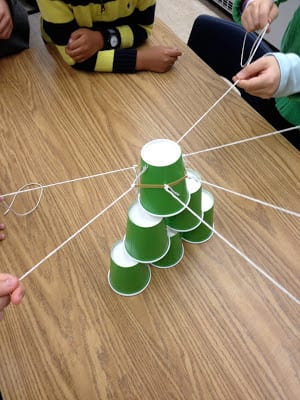
22. No-hands cup-stacking challenge
Source: Nick Cornwell
This hands-on group claiming is an exercise in patience and perseverance, not to mention a full blast! Make up one's mind how many students you want in each grouping and tie that number of strings to a unmarried rubber band, making i for each grouping. Each person in the group holds onto one of the strings attached to the rubber band, and, every bit a grouping, they use this device to selection upwards the cups (by expanding and contracting the condom band) and identify them on top of each other in order to build a pyramid. See detailed instructions here.
23. Tick tock
This action helps students negotiate and work together toward a common goal. Make a list of tasks on nautical chart paper, assigning a point value for each job. For example: Exercise 25 jumping jacks (5 points); brand up a nickname for each member of the form (five points); become every person in the class to sign a piece of paper (fifteen points); grade a conga line and conga from i end of the room to the other (5 points, ten bonus points if anyone joins yous); etc. Make sure you list enough tasks to take upward more ten minutes. Separate your students into groups of 5 or 6 and requite them 10 minutes to collect as many points as they can by deciding which tasks from the list to perform.
24. Body parts
Students mingle around the classroom until you call out a body part and a number, for case, "four knees!" Students have to form a group of four students closest to them (finding new partners each time) and join together one human knee each or a group of two with both knees together. Anyone who isn't part of a grouping gets to phone call the adjacent circular.
25. Human being alphabet
You need a big open space for this game. Have students spread out and guide them through a few rounds of forming letters with their bodies. For instance, "Utilise your body to brand a T … now make an O!"
Next, call out a unproblematic short give-and-take, such every bit "so" or "dog." Students will have to team up to course the give-and-take, with each student using their body to form 1 of the letters. Start with two-letter words, so three, and then 4. If students want a claiming, come with a phrase that will take the whole class to consummate.
26. Applause, please
Form groups of between three and v students. I person from each group (the finder) steps out of the classroom. The rest of the group picks an object (for instance, the pencil sharpener) in the classroom for the finder to discover. When the finder comes back in, they begin walking effectually the classroom in search of the object. The others cannot say annihilation, but they can give hints by using applause to pb the finder in the correct direction. If the finder is far away from the object, the group volition clap slowly and softly. When the finder gets close, the group will applaud faster and more than loudly until the finder picks the correct object.
27. Caterpillar
Separate students into groups of four. Lay out four hula hoops per group and accept one pupil stand in the middle of each one to form teams of "caterpillars." Line all of the teams up at the end of a field or large open infinite. Set out 4 or v objects in front of the lines, such equally cones, foam blocks, or balls.
The goal of the game is to collect as many objects equally possible by moving the caterpillar frontward. To move forrard, the last histrion in line steps into the hoop with the player in forepart of them, picks upward their empty hoop, and passes it overhead to the front of the line. The front player then places the hoop on the ground in front of them and steps into it. Every player then shifts forrard, moving the caterpillar. Only the front end player may choice upward objects, but it is the team'southward chore to carry the nerveless objects throughout the game. The game ends when there are no more objects on the ground. Observe more detailed instructions here.
28. Golf game ball trampoline
Divide the grade into teams of six or eight. Provide each team with a large bedsheet or tarp that has several slits cut into it, and have students concord onto the edges and spread the sheet out so that it is tight. Place a golf brawl in the middle of the sail. Students must work together to maneuver the ball around the sail without having it autumn through one of the slits. When a team'due south brawl falls through, they are out and must sit until there is only one team left. Mix up teams and kickoff over once again.
29. All aboard!
For this action, you volition demand a few jump ropes. Divide students into groups of vi or eight. Take each group brand a circle with their spring rope (their "lifeboat") on the ground and then that the ends are touching. Now accept all the members of each group become into their lifeboat. This should be like shooting fish in a barrel the showtime time. Then have all players get out and reduce the size of their circle past one foot. Again, all players need to get into the boat. Repeat this process, making the lifeboat smaller and smaller while you watch your students come up upward with creative solutions for making sure that everyone fits safely inside their gunkhole.
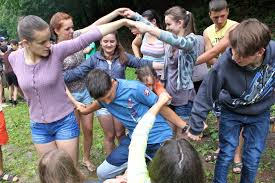
30. Pretzel, unpretzel
Source: Icebreaker ideas
Divide your class in one-half and take each group cull one pretzel maker and 2 unpretzelers. Direct the unpretzelers to turn their backs. Have the rest of the students in each grouping form a circumvolve and hold hands. Now, have the pretzel maker direct the students (with words simply) to twist effectually, pace over, and duck under each other'due south artillery to form a human pretzel. In one case they are sufficiently twisted, call the unpretzelers over and have them try to directly the students (with words only) in guild to detangle them. Students cannot drop their hands at whatsoever time. The get-go squad that successfully unpretzels their grouping wins.
31. Artistic solutions
This activity encourages creative problem-solving. Pick iv or more than unlike objects, such as a java can, a murphy peeler, a knit lid, and a book. Split students into fifty-fifty teams. At present present a situation where each team has to solve a problem using simply those objects. These scenarios tin exist anything from students are stranded on a desert island and must observe a way to become off or survive to students must save the world from Godzilla. Give the teams five minutes to effigy out an original solution to the scenario, including ranking each object based on its usefulness. When the five minutes are upwards, accept each team nowadays their solution forth with their reasoning to the class. (Tip: Don't make the scenarios and then easy that information technology is obvious which objects will be nigh useful.)
32. Zip, zap, zop
This game is all most focus and energy. As students laissez passer the free energy beyond the circle (in the grade of a Zip, a Zap, or a Zop), they make heart contact with the person they send the energy to and work together to keep the rhythm going. To laissez passer the energy, have students put their hands together in a teepee in front of their chest. Player 1 moves their easily away from their breast, makes eye contact with and points at a classmate, and says "Cypher." Then that student repeats the process with another pupil and says "Zop." That player repeats with a "Zop," so it starts all over with "Zip." Brand certain students are making eye contact when they laissez passer the energy. To make sure anybody is picked, students can put their hands down at their sides later on their turn.
33. Spider web
This squad-building game will teach your students that even though they may be different in many ways, they are yet continued to ane another. Gather in a circle, standing or sitting. The game begins when the first person, holding a large ball of twine, tells the group a funny or embarrassing story nigh themselves. In one case they cease, they will concur onto the stop of the twine and throw the ball to someone else in the circumvolve. That person grabs concord and tells a funny or embarrassing story about themself and then passes information technology on to another pupil. Play continues until the twine has been passed to each person. The stop result will produce a "web" out of the twine, connecting each student to all of the others.
What are your become-to team-building activities in the classroom? Share your favorites in our WeAreTeachers HELPLINE grouping on Facebook.
And for more than means to connect with your students nearly, cheque out xx fun Zoom games for kids.
akbarsomakingdon61.blogspot.com
Source: https://www.weareteachers.com/team-building-games-and-activities/
0 Response to "Summer Reading Challenge Libraries Rock T Shirt"
Post a Comment